tags: math, cryptography
Mathematicians couldn’t use certain operation families on computers due to the presence of some irreversible operations. Integer operations couldn’t be used due to irreversible multiplication and the same for arithmetic, the value in the end would get truncated. Bitwise operations also couldn’t be used due to irreversible operations like and operation.
The idea of finite fields
Groups
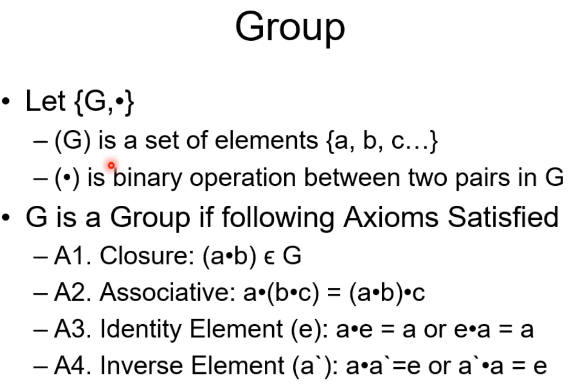
When we define a group we say , the some operation is a binary operation that can be applied to any two pairs in the group and will result an element in the group
The inverse element is unique element for every element in the set, not a single element that applies to all.
The Axioms above are really important
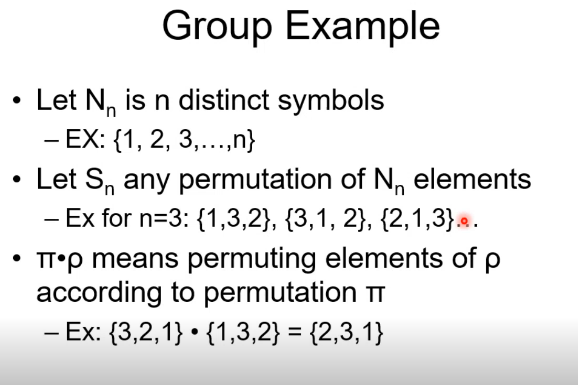
Example:
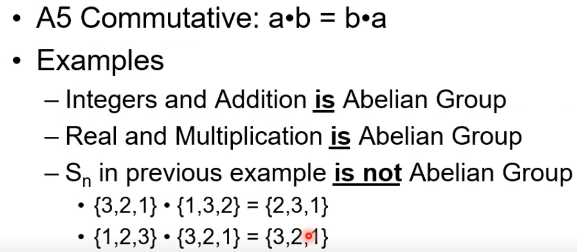
Abelian Groups
Abelian groups add fifth axiom that allow operation commutativity
Rings
They define addition and multiplication for the operations and must satisfy more axioms
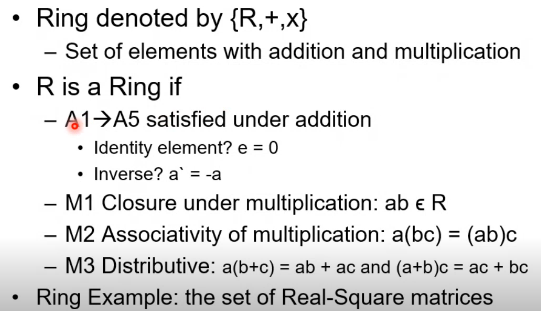 The addition and multiplication here aren’t really literal addition and multiplication, instead they are operations where the “addition operation” satisfies addition axioms from A1 to A5 and the “multiplication” operation satisfies multiplication axioms M1 to M3 or more.
Commutative rings
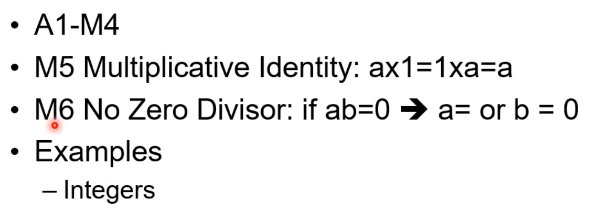
Same as normal rings but define axiom M4 that defines commutative under multiplication. An example for commutative ring group are even integers.
Integral domains
They add even more axioms
Fields
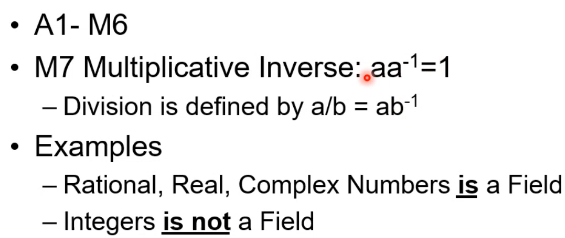
Lastly fields define all the previous axioms and add some more, fields mostly differ in the axiom of the multiplicative inverse.
Cyclic Groups
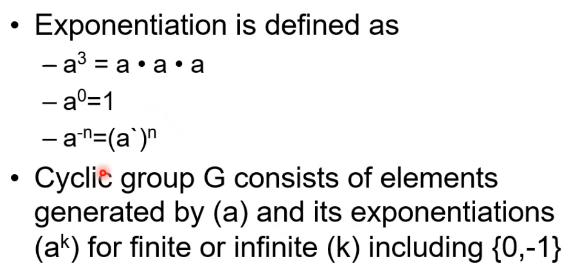
They are a group on their own and define their elements based on exponentiation.
Finite fields in the form GF(p)
GF(p) is a set of integers where is prime, and GF(p) stands for Galois Field of order p, after all it is just a field that as we defined before.